Slot Machine Payout Cycles Explained
Players often talk about machines running "hot" or "cold," about a machine being "due" for a jackpot, or about the best time to play. Almost all of these beliefs misunderstand how slot machines actually work.
This guide explains the mechanics honestly — RTP, volatility, and the role of the Random Number Generator — so you can approach every visit to Cicero Slots with accurate expectations.
If you're a regular player and want to understand how to get more value from your time at the casino, the Players Club membership guide explains the benefits structure in full.
The Random Number Generator: The Foundation of Everything
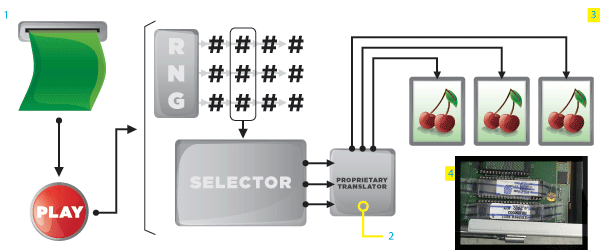
Every modern slot machine — mechanical or video — is controlled by a Random Number Generator (RNG), a microprocessor that continuously generates number sequences at a rate of hundreds per second. The moment you press the spin button, the RNG's current output determines the result.
The critical implication: each spin is completely independent of all previous spins. The machine has no memory. A machine that hasn't paid a jackpot in two weeks is not "due." A machine that paid a jackpot five minutes ago is not "cold." The probability of any outcome is identical on every single spin.
This is not a simplification. It is how the technology works.
Return to Player (RTP): The Long-Run Average
RTP (Return to Player) is the percentage of total money wagered that a slot machine pays back to players over a very large number of spins.
- A machine with a 96% RTP returns $96 for every $100 wagered — on average, over tens of thousands of spins
- Your individual session result can vary dramatically from the RTP figure
- Some sessions will exceed the RTP; most sessions on high-volatility machines will fall well below it
RTPs in 2026 typically range from 94% to 97% on most slot titles. The same game can ship to different casinos with different RTP versions — some operators choose the higher RTP build, others the lower. Where permitted by regulation, this information may be posted or available on request.
Volatility: How Wins Are Distributed
RTP tells you the long-run average. Volatility (variance) tells you how wins are distributed — the shape of the experience.
| Volatility | Win Frequency | Win Size | Best For |
|---|---|---|---|
| Low | Frequent | Small | Longer sessions, smaller bankroll |
| Medium | Balanced | Balanced | Most general play |
| High | Rare | Potentially large | Big jackpot hunting, larger bankroll |
Example: Two machines both have 96% RTP.
- Machine A (low volatility): pays $0.50–$2.00 frequently, rarely above $50
- Machine B (high volatility): pays nothing for 50 spins, then pays $500 in a bonus round
Both return the same average over time. The experience is completely different.
Payout Cycles: What This Term Actually Means
The phrase "payout cycle" is sometimes used to imply a machine runs through a sequence of wins and losses in a predictable pattern. This is not how RNG-based machines work.
What "payout cycle" legitimately refers to:
- The statistical distribution of outcomes for a given game, as defined by its RTP and volatility
- The fact that high-RTP machines may include more frequent small wins in their design to maintain engagement
- The mathematically expected range of results over a given number of spins
There is no cycle that can be observed, tracked, or predicted from outside the machine. The RNG outputs are not publicly knowable in real time. The PAR sheet (Probability and Accounting Report) for a given game is not public — it's held by the manufacturer and regulatory authority.

The Myth of "Hot" and "Cold" Machines
The feeling that a machine is "hot" is a normal psychological response to a winning streak within a random distribution. The feeling that a machine is "cold" is the same response to a losing streak.
Both are real experiences within the statistical reality of variance. Neither is evidence of a pattern.
This doesn't mean every machine is identical. Volatility and RTP are real differences between machines. A machine with a high RTP and low volatility will, over time, produce more frequent small wins than a low RTP, high volatility machine. That's a real, verifiable difference. It's just not visible in any single session.
Practical Takeaways for Players
- Bankroll management is the only real strategy. Decide before you sit down how much you're willing to spend. Treat it as the cost of entertainment.
- Choose volatility to match your session goal. If you want to play for two hours, low volatility extends your time. If you're chasing a big win with a limited session budget, high volatility gives you that chance — but most sessions will be shorter.
- Players Club points are earned on coin-in. Every spin, regardless of outcome, earns points. This is the only guaranteed return for your play — which is why joining the Players Club before your first session is always worth doing.
- RTP is not a session guarantee. You can lose 40% of your bankroll on a 96% RTP machine in a single hour. Variance is real.